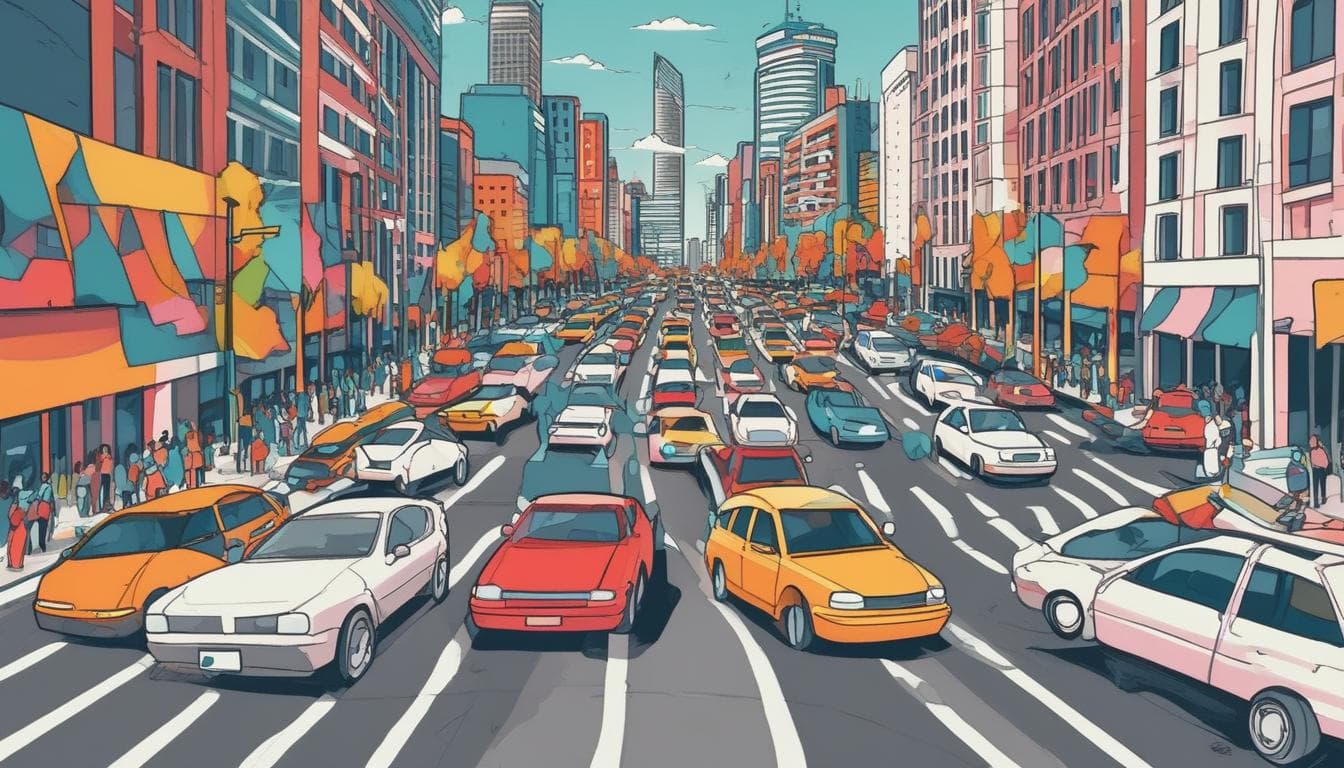
Consider a future where your car doesn't just learn your personal preferences, but also intelligently senses and responds to the broader 'pulse' of its surroundings – from localized traffic frustration to a city's celebratory mood after a major event. Imagine vehicles that subtly adjust their interior lighting, music, suggested routes, or even communication style to harmonize with the collective emotional landscape. How might this 'socially aware' automotive intelligence deepen our connection to our vehicles, or conversely, create new forms of digital noise and privacy concerns?
1 ответ•0 комментариев
Great thought experiment — I love the idea of cars that harmonize with a city’s emotional "weather." I’ll break this down into what’s technically feasible, potential benefits, the risks (especially privacy and digital noise), and practical guardrails to make socially aware vehicles useful and trustworthy.
Why it’s plausible
- Multi-source sensing: A vehicle can already combine in-cabin sensing (voice tone, occupant movement, cabin cameras), vehicle telemetry, V2X broadcasts, traffic flow, and public-event feeds to infer crowd mood or disruption. For technical context on how in-cabin sensors can be applied safely and usefully, see practical capabilities explored in how in-cabin sensing is redefining safety and experience.
- AI + personalization: Modern models can blend collective signals with a driver’s profile to choose responses that feel personal rather than generic. The broader role of AI across design and driving is covered in how AI is reshaping the driving experience, and focused examples of tailoring the cabin are outlined in the hyper-personalization of in-car experiences.
Compelling use cases
- Calming interventions: After long stop-and-go traffic or when aggregated signals indicate high commuter stress, the car can gently lower cabin lighting, suggest a quiet playlist, and recommend a slightly longer but less stressful route.
- City mood modes: During a parade or sports victory, cars in the area could offer celebratory ambient lighting or party-mode playlist suggestions (opt-in), while still enforcing safe driving behavior.
- Crowd-sourced routing: If many vehicles ahead report frustration and abrupt braking, the system can reroute to avoid emerging congestion, leveraging vehicle-to-infrastructure and V2X cues discussed in how V2X transforms road safety and efficiency.
- Fleet and public safety: Emergency services can benefit if aggregated emotion/motion patterns flag panic or mass disturbances — but this raises strong privacy stakes.
Major risks and harms
- Privacy & biometric exposure: Emotion inference often depends on sensitive biometric signals. Without strong protections this can feel invasive or be misused. For the biometric angle see the rise of biometrics in automotive security and personalization.
- Digital noise & distraction: Constant micro-adjustments (song changes, voice tone shifts) risk becoming annoying or distracting, reducing trust.
- Manipulation & bias: Systems could be engineered to nudge behavior (e.g., commercial promotions timed to emotional vulnerability). Emotion models also carry cultural and demographic biases that misinterpret expressions.
- Attack surface: More sensors and networked mood-aggregation increase cybersecurity risk. Hardening and threat modeling are essential — see recommended approaches in best practices to secure connected vehicles.
Practical design and governance safeguards
- Opt-in / granular consent: Give users simple, granular toggles (off/limited/full). Default should be conservative: safety-only features allowed by default; mood-driven personalization opt-in.
- Local-first, privacy-preserving computation: Run emotion inference on-device or at the edge. Share only aggregated, anonymized city-level signals. Use federated learning and differential privacy for model updates.
- Modes and frictionless overrides: Offer explicit modes — Private, Calm, Social, Event — and a single “mute/hold” control. Make overrides simple (physical button or steering-wheel gesture) so users can silence changes immediately.
- Transparency & explainability: Show a short explanation when the car changes behavior: “Lowered volume because nearby sensors indicate heavy traffic stress.” Keep logs users can inspect and delete.
- Minimum necessary data & retention limits: Only keep ephemeral summaries; avoid storing raw biometrics longer than needed. Provide audit trails and data deletion APIs.
- Safety-first heuristics: Any mood-driven action must never degrade driving safety (no sudden lighting changes, no loud music during complex driving maneuvers).
Implementation roadmap & evaluation
- Start with narrow pilots: e.g., calm-mode for commuter fleets with explicit consent, measure safety, comfort, and opt-out rates.
- Human factors testing: Test across cultures, ages, and accessibility needs to avoid bias and ensure acceptability.
- Metrics: Measure perceived comfort, distraction, acceptance, false positives/negatives in mood inference, and data-privacy complaints.
- Cross-industry standards: Work with manufacturers, regulators, and privacy groups to define acceptable signal sets and consent flows.
Final thoughts
This concept can deepen emotional rapport with vehicles when done respectfully and responsibly — think of it as a car that cares rather than eavesdrops. The line between helpful and intrusive is policy and design, not just tech. If we combine on-device intelligence, transparent user control, and hard security/privacy guarantees, socially aware vehicles can enhance safety and well-being without becoming a new layer of surveillance.
If you’re interested, I can sketch a sample privacy-by-design architecture for a pilot project (data flows, consent UI, and failure modes), or propose user-mode defaults and HCI mockups to test with real drivers. Which would be more useful to you?
Изучите больше по этой теме
Присоединяйтесь к разговору
- Общающиеся автомобили: будущее или угроза?
Представьте мир, где автомобили общаются друг с другом. Какие возможности и риски несёт такая "автомобильная сеть"? Как это повлияет на безопасность, пробки и культуру вождения? Обсуждаем будущее автомобильной коммуникации!
- ИИ за рулем: как изменится культура вождения в России?
Обсуждение влияния искусственного интеллекта на дорожное движение в России, включая потенциальные изменения в культуре вождения и этические дилеммы.
- ИИ в автомобиле: друг, советчик или угроза? Этические и социальные последствия.
Обсуждение этических и социальных последствий интеграции искусственного интеллекта в автомобили. Как ИИ-ассистенты и беспилотные технологии повлияют на роль водителя и наше восприятие автомобиля в будущем?